Steve McQueen - Atlas
Steve McQueen has always occupied a rare space between artist and filmmaker, moving fluidly between cinema, installation and political reflection without ever fully belonging to one discipline. Whether through the physical intensity of Hunger, the historical brutality of 12 Years a Slave or the deeply human portraits inside Small Axe, his work consistently examines the relationship between memory, power, race and lived experience. Now, De Pont Museum in Tilburg is bringing that vision into focus with ATLAS, McQueen’s first solo exhibition in the Netherlands.
Running from 21 March to 30 August 2026, the exhibition presents four major works that together form an expansive meditation on history, space, trauma and perception. At its centre is the world premiere of Atlas (2026), a newly commissioned work created specifically for De Pont Museum, alongside Sunshine State (2022), Untitled (2025) and Bounty (2024). Together, the exhibition positions McQueen not only as one of the defining filmmakers of his generation, but as an artist deeply engaged with the emotional and political dimensions of image-making itself.
The newly commissioned Atlas marks a striking shift in scale. Created using astronomical data from the European Space Agency’s Gaia mission, the work transforms scientific observation into an immersive visual experience. Collaborating with davidkremers, Julian Humml and Alejandro Stefan Zavala, McQueen uses machine learning systems to reinterpret telescope data into something both empirical and poetic. The result is less a straightforward representation of outer space than an attempt to confront the vastness of existence itself — a journey through scale, time and perception that feels equally grounded in science and imagination.

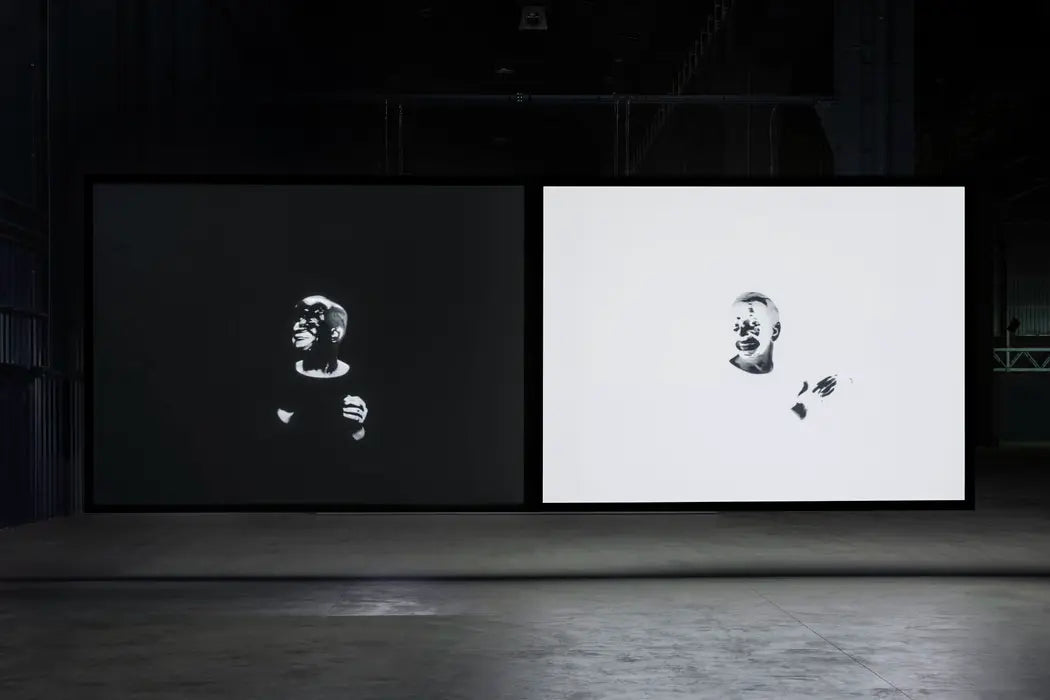
That cosmic perspective is balanced by Sunshine State, one of McQueen’s most emotionally layered recent works and now part of the De Pont collection. Originally commissioned by the International Film Festival Rotterdam, the multi-channel installation intertwines fragments of film history with McQueen’s own family narrative. The work traces the story of his father, who migrated from Grenada to Florida in the 1950s to work in the orange harvest, while simultaneously reworking footage from The Jazz Singer (1927), the first feature-length sound film in cinema history — infamous for Al Jolson’s use of blackface.
McQueen manipulates the archival material through reversals, distortions and altered speeds, creating a fragmented visual language where memory becomes unstable and historical imagery begins to collapse into something more haunting and unresolved. Across the installation, silences and absences become as important as the images themselves, exposing the ways personal trauma and colonial histories continue to shape one another across generations.
Elsewhere in the exhibition, Bounty (2024) offers a quieter but equally charged meditation on history and place. The 47-part photographic series documents flowers and plants from Grenada in vivid states of bloom and decay. On the surface, the images appear tranquil and almost meditative, but beneath that beauty lies a deeper reflection on colonial extraction, survival and regeneration. Even the title carries dual meaning: bounty as abundance, but also bounty as plunder.

The series will also be accompanied by a newly published catalogue from MACK, featuring Derek Walcott’s poem The Bounty alongside a new text by poet and novelist Dionne Brand. Like the exhibition itself, the publication extends McQueen’s interest in connecting visual language with historical and emotional memory.
Taken together, ATLAS feels less like a conventional museum exhibition and more like a series of interconnected meditations on how we experience time, history and physical presence. Across film, sound, photography and data-driven installation, McQueen consistently asks viewers to confront what remains unseen beneath surfaces — whether that means inherited trauma, erased histories or the sheer incomprehensible scale of the universe itself.
Few artists move as comfortably between radically different mediums while maintaining such a distinct emotional and political clarity. From the experimental films that earned him the Turner Prize in the 1990s to Oscar-winning cinema and large-scale installations, McQueen’s practice has always resisted categorisation. What connects the work is a persistent attention to vulnerability: the body under pressure, memory under strain, and history as something both deeply personal and collectively lived.
With ATLAS, De Pont Museum presents McQueen at a moment where those ideas feel more expansive than ever. The exhibition moves from the intimate to the cosmic without losing sight of the human experience at its centre. In doing so, it offers a powerful reminder that Steve McQueen’s work has never simply been about images — it has always been about what images carry, conceal and reveal.